
The village did not empty itself in a single night.
It thinned slowly—like mist lifting from the hills.
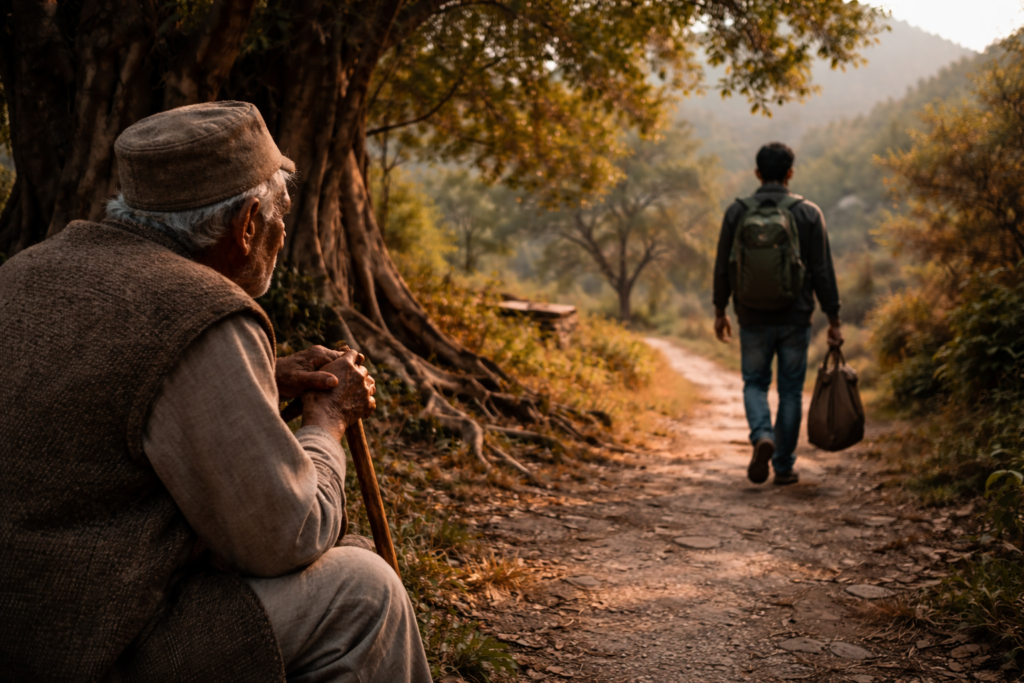
One house at a time.
First went the young men.
Then the children.
Then the laughter.
Why People Leave
In the beginning, leaving was not betrayal.
It was survival.
The fields no longer fed every mouth.
The rains grew unpredictable.
Schools closed when teachers stopped coming.
Hospitals were hours away, sometimes days.
Parents looked at their children and made the hardest decision of all.
“If we stay, they will grow like us.
If we leave, maybe they will grow beyond us.”
So they left.
For jobs in plains where the air was heavier but opportunities were lighter on the soul.
For cities where money came faster, but nights were lonelier.
For futures that did not include these hills—at least not immediately.
Every departure carried a promise:
“We will come back.”
But promises fade when roots are stretched too far.
The Cost of Leaving
Leaving did not mean forgetting.
People carried the village with them—in accents that never softened,
in food that tasted wrong outside these mountains,
in festivals celebrated alone in rented rooms.
But slowly, life adjusted.
Children learned new languages.
Parents aged in cities.
Return became “next year”, then “someday”.
And someday became silence.
Why Some Stay
Yet, not everyone left.
Some stayed because they could not imagine waking up anywhere else.
Some stayed because the land still responded to their touch.
Some stayed because someone had to light the temple lamp.
And some stayed simply because their hearts refused to move.
The old man at the edge of the village stayed because—
“If everyone leaves, who will remember?”
He stayed to unlock doors that no one entered.
To sweep courtyards that no one crossed.
To talk to houses that answered only in echoes.
For him, staying was not stubbornness.
It was duty.
Two Lives, Two Truths
Those who left are not wrong.
Those who stayed are not foolish.
Both choices came from love—just expressed differently.
One loved the future enough to leave.
The other loved the past enough to stay.
And somewhere between the two lies the true story of Kumaun’s villages—
not abandoned,
not alive,
but waiting.
Waiting for footsteps.
Waiting for voices.
Waiting for return.
A Question That Lingers
As the sun dips behind the ridges and the village settles into silence,
one question hangs heavier than the mountain air:
If everyone leaves to build a better life,
who stays behind to keep the soul alive?