
The village did not disappear the day the school closed.
But that was the day it began to forget how to breathe.
A Bell That Once Ruled the Day
There was a time when everything in the village moved to the rhythm of the school bell.
It rang in the morning, sharp and hopeful.
It rang again before noon, restless and impatient.
And in the afternoon, it rang softly—like permission to be free.
Children spilled out into narrow lanes, laughter bouncing off stone walls. School bags were dropped carelessly. Dust rose. Games began. Life followed.
The school was small.
Two rooms.
One blackboard.
Few teachers.
But it held the village together.
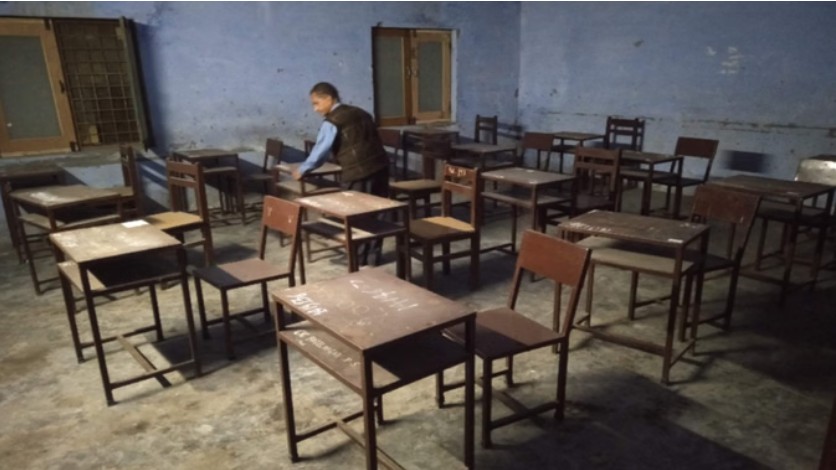
The First Empty Bench
It started quietly.
One child left—his father had found work in the plains.
Another followed—her mother wanted a better school.
Then two more.
Then three.
Benches grew emptier, not suddenly, but steadily. Teachers adjusted. Classes merged. Lessons shortened.
No one panicked.
Everyone believed this was temporary.
Villages survive on belief.
When Teaching Became Waiting
Teachers still arrived on time.
Registers were filled carefully.
Lessons were taught—sometimes to only two or three children.
The blackboard did not complain.
The walls did not question.
But the silence grew heavier.
A school without children is not closed.
It is waiting.
The Day the Bell Rang for the Last Time
No announcement was made.
One year, admissions did not come.
The next year, transfers were issued.
And one morning, the bell rang—once.
Then never again.
The doors were locked.
The playground surrendered to weeds.
Books gathered dust.
The school did not shut down loudly.
It simply stopped existing.
What a Silent School Means
A closed school is not just a building problem.
It means:
- no reason for families to stay
- no future imagined locally
- no childhood rooted in the village
Without a school, a village has no tomorrow—only memory.
Children are the promise of return.
When they leave, return becomes optional.
The Long-Term Silence
Years passed.
The school still stands—on paper.
On records.
On government lists.
But no one walks its path anymore.
Occasionally, someone unlocks it—for inspection, for photos, for reports.
The door opens.
The silence remains.
A Question No One Answers
People speak of roads, hospitals, internet.
But no one asks the simplest question:
How can a village live if it cannot teach its children?
When schools fall silent, villages follow.
Not immediately.
But inevitably.
This Silence Still Echoes
Across Kumaun, many villages share this story.
Schools stand locked.
Benches wait.
Blackboards fade.
And with each silent school, another village edges closer to disappearance.
This is not just about education.
It is about existence.
The Series Continues
This chapter is not an ending.
It is a warning.
Because when schools fall silent, villages do not vanish overnight—but they begin to disappear from the future.