
Somewhere between the ridgelines of Kumaon, where the terraces climb like green staircases toward the sky, there are fields that no longer grow anything but grass, bramble, and silence. This is one story from that quiet, growing category of places in Uttarakhand often called ‘ghost villages’ — settlements where the houses still stand but the fields around them have gone wild, untouched by a plough for years. What follows is not the story of one famous village but a composite portrait of the kind of place you find again and again if you walk far enough off the motor road in Almora, Bageshwar, Pithoragarh, or Nainital districts. Consider it an invitation to go find your own version of it, and to fill in the details with what you actually see.
Where This Kind of Village Sits
Villages like this are typically found at altitudes between roughly 1,400 and 2,200 metres, tucked into the middle Himalaya where oak and pine forests give way to terraced hillsides. They are usually a few kilometres — sometimes an hour or more of walking — from the nearest motorable road, and further still from a proper town with a market or a bus stand. Almora, Bageshwar, Someshwar, and Kausani are common gateway towns for this kind of exploration, each with guesthouses, shared taxis, and onward jeep routes into the interior. From these towns, a local shared taxi or hired vehicle will usually get you to the roadhead nearest such a village, after which the rest of the journey is on foot along old bridle paths that once connected these hamlets to the wider valley.
First Impressions
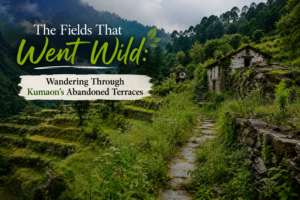
Approaching one of these villages for the first time, the landscape often gives itself away before the houses do: terraces that should be a patchwork of mustard yellow, wheat green, or ripening millet are instead a uniform tangle of wild grass, lantana, or bracken fern. The stone retaining walls, built and rebuilt over generations, are frequently still intact, holding up fields that no one seeds anymore.
The Walk In
The paths leading to such villages are usually old ones — foot trails that predate any road, worn smooth by decades of use by farmers, schoolchildren, postmen, and mule trains carrying supplies. Walking them today, you might pass abandoned water channels, crumbling cattle sheds, or small shrines that are still, curiously, kept swept and lit despite the general emptiness around them.
[ADD YOUR OWN EXPERIENCE/PHOTOS HERE]
People Along the Way
Most such villages are not entirely empty. A handful of households often remain — usually elderly residents who have chosen to stay, sometimes joined by younger family members during festivals or the harvest of what little is still cultivated close to home. Conversations along the trail, at a roadside tea stall, or in a village courtyard tend to circle around the same themes: children and grandchildren settled in Haldwani, Dehradun, Delhi, or further away; fields that have gone out of use because there is no one left to work them; and a quiet, unresentful acceptance of how much has changed.
What’s Vanishing
The disappearance here is not dramatic; it is administrative and agricultural before it is anything else. Uttarakhand has, over recent decades, seen substantial outmigration from its hill districts, a pattern widely documented by the state’s own rural development and migration commissions. The reasons are practical rather than mysterious: limited irrigation, small and fragmented landholdings, human-wildlife conflict affecting crops, better education and employment opportunities in the plains, and the physical difficulty of hill farming without adequate roads or markets. As families leave, terraces once needed to feed a household lie fallow, and fallow land in this climate does not stay bare for long — it is quickly reclaimed by weeds, shrubs, and eventually forest.
- Terraced fields reverting to grassland or scrub within a few seasons of disuse
- Traditional water channels and irrigation systems falling into disrepair
- Seed varieties and cropping knowledge specific to a household or hamlet fading with the last farmers who practiced them
- Community structures — schools, ration shops, panchayat houses — operating at a fraction of their intended capacity
Practical Notes for Visitors
If you want to see this landscape for yourself, a few general points are worth keeping in mind. Base yourself in a recognised town such as Almora, Bageshwar, or Kausani, where you can arrange local transport and get current advice on trail conditions. Always ask locally about the state of paths and any recent weather before setting out, especially during and just after the monsoon months. Carry water, a map or offline GPS track, and be prepared for a lack of mobile network once you are off the main road. Most importantly, remember that a village with only a few remaining residents is still someone’s home — approach it with the same courtesy and restraint you would want shown to your own.
Closing Reflection
What stays with most visitors to places like this is not sadness exactly, but a kind of respectful attention — an awareness that a way of life shaped these hillsides for generations, and that its quiet withdrawal is leaving behind a landscape that is, in its own overgrown way, still beautiful.