
He lived alone in a village that no longer remembered how to speak.
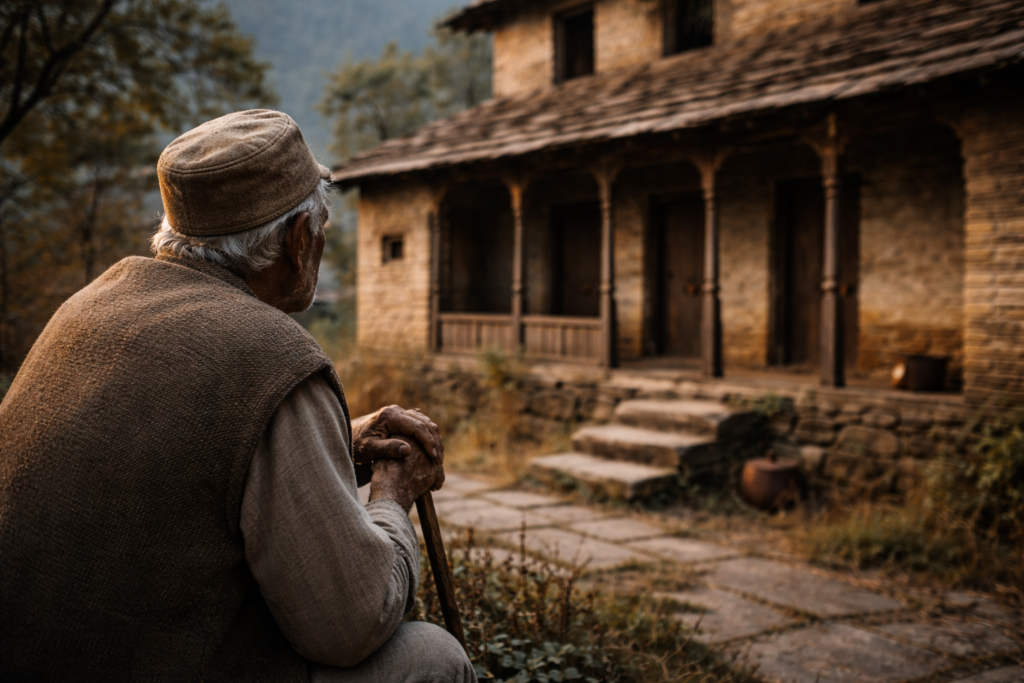
The Man Who Stayed
When everyone else left, he stayed.
Not because he had nowhere to go—
but because he believed someone had to remain.
His house stood at the edge of the village, close to the temple and the old peepal tree. Every morning, he swept the courtyard carefully, as if guests might arrive. Every evening, he sat on the stone step, watching the road that once brought people home.
The road was empty.
But he watched anyway.
A Life Measured in Memories
The elder did not count years anymore.
He counted absences.
The family that left first.
The children who never returned.
The festivals that grew quieter each year.
He remembered every house when it was full—who lived where, whose laughter belonged to which courtyard, which door creaked louder than others.
Now, the houses stood locked.
He knew all their stories.
Keeper of Keys and Rituals
Some families trusted him with their keys.
“Just in case,” they said.
So he became the caretaker of homes not his own. During festivals, he opened doors, cleaned rooms, lit lamps. He offered prayers on behalf of people who now lived far away but still believed someone was watching over their village.
He also rang the temple bell.
Every morning.
Every evening.
Even when no one came.
Conversations With Silence
In the afternoons, the village fell completely still.
No footsteps.
No voices.
Only wind moving through trees and prayer flags that no longer knew the names of worshippers.
The elder spoke to the silence sometimes.
Not because he was lonely—but because silence, too, deserves acknowledgment.
Why He Never Left
When asked why he stayed, he answered simply:
“If I go, the village becomes memory.
As long as I am here, it still exists.”
For him, staying was an act of resistance.
Against forgetting.
Against erasure.
Against the idea that villages must vanish quietly.
The Day He Left
He did not announce his departure.
Age made the hills steeper. Illness made the nights longer. One winter, he locked his door carefully—just like everyone else had done before him.
He rang the temple bell one last time.
Then the sound stopped.
After the Last Elder
The village changed that day.
Not physically—
but spiritually.
Without the elder, no one remembered the rituals exactly. No one knew which lamp was lit first, which prayer was whispered softly, which stories belonged to which house.
The village still stood.
But no one belonged to it anymore.
What His Absence Means
A village does not disappear when people leave.
It disappears when the last memory keeper goes.
The elder was not just a resident.
He was the village’s conscience.
Still, He Remains
Even now, people speak of him in the present tense.
“The elder knows.”
“The elder will tell.”
As if he might return.
As if villages, like people, never truly leave—
they just wait to be remembered.
This Chapter Is for Him
For every elder who stayed behind, holding villages together with memory, ritual, and quiet courage.
When they leave, villages do not fall.
They fall silent.