
Every place has a flavour.
But Kumaun has a taste that feels like memory.
You do not discover Kumauni food in restaurants.
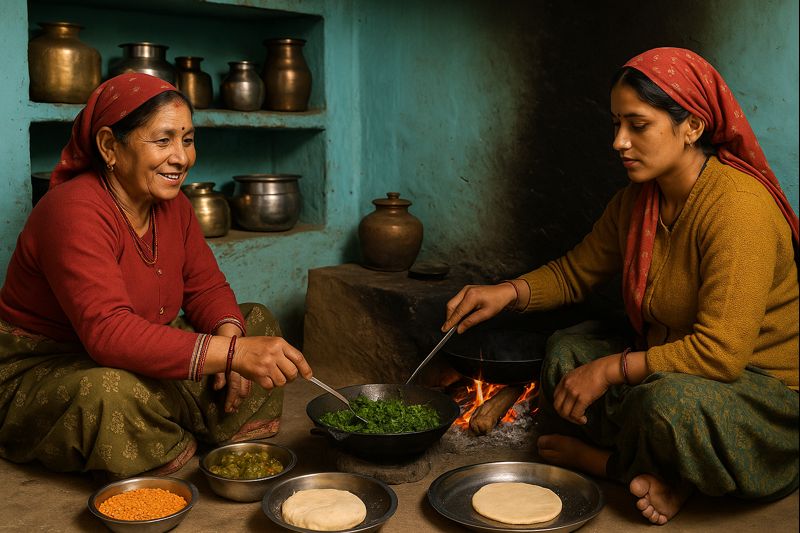
You discover it in kitchens—small, smoke-filled rooms where walls have absorbed decades of stories, and every meal is cooked with patience rather than precision.
A Kumauni kitchen does not rush.
It waits.
Where Fire Becomes Family
In many homes, the heart of the kitchen is still the chulha—a wood-fired stove blackened by years of use. Pinewood crackles softly. Smoke curls upward, escaping through windows left intentionally open.
Here, fire is not just for cooking.
It is for gathering.
Children sit nearby, warming their hands on winter mornings. Elders rest against the wall, offering instructions that are never written but always remembered. Conversations unfold slowly, between the stirring of pots and the grinding of spices.
Food here is not prepared alone.
It is prepared together.
Ingredients That Come from the Land
Kumauni cuisine does not rely on excess.
It relies on what the land gives.
Mandua (finger millet) grown on terraced fields.
Bhatt (black soybean) dried carefully in the sun.
Jhangora harvested after the rains.
Fresh greens picked from forest edges.
Spices ground at home—coarse, fragrant, alive.
Nothing is wasted. Everything is respected.
The food tastes honest because it begins honestly.
The Quiet Magic of Everyday Dishes
There is no ceremony when madua roti is cooked. The dough is pressed gently, shaped by hand, and placed on the fire. When it is ready, it carries the faint sweetness of the grain and the strength of the hills that grew it.
Bhatt ki churkani simmers slowly, dark and comforting, thick with warmth.
Jhangora ki kheer is cooked without hurry, creamy and subtle, meant to be eaten when the day has softened.
These dishes do not impress at first bite.
They stay with you.
Food That Carries Memory
For those who have left the hills, Kumauni food becomes memory made edible.
A single bite can summon an entire childhood—winter evenings, school holidays, rain tapping on tin roofs, mothers calling everyone in for dinner before the food grows cold.
In cities, these flavours are recreated, but never fully repeated. Something always remains missing.
Perhaps it is the mountain air.
Perhaps it is the silence.
Perhaps it is the feeling of being home without trying.
Festivals That Taste Different
On festival days, the kitchen transforms.
Large pots are brought out. Extra hands appear. Laughter grows louder. Singal, pua, and special sweets fill the air with sweetness and anticipation.
Food becomes celebration—not extravagant, but abundant.
Every dish carries a blessing.
Every meal marks belonging.
A Taste That Teaches Simplicity
Kumauni kitchens teach a quiet lesson: that nourishment is not about variety, but about balance. About eating what sustains you. About understanding seasons. About gratitude.
The food does not overwhelm the senses.
It grounds them.
And long after the plate is empty, the taste remains—steady, familiar, reassuring.
Like home.
Why Kumauni Food Never Leaves You
Because it was never meant to impress strangers.
It was meant to feed families.
Because it carries the wisdom of mountains that know survival.
Because it is cooked with hands that love more than they measure.
You may forget the names of the dishes.
You may forget the recipes.
But you will never forget how Kumauni food made you feel.
Full.
Warm.
Home.