
Some places speak through sound.
Others speak through silence.
Jageshwar speaks through the forest.
Hidden deep within deodar trees of Kumaun, Jageshwar does not reveal itself all at once. It unfolds slowly—stone by stone, step by step—until you realize that you are no longer merely visiting a temple complex. You are entering a conversation that began thousands of years ago.
The Road That Softens the Mind
The journey to Jageshwar itself feels intentional. As the road leaves the noise of towns behind, the forest grows denser. Deodar trees rise straight and tall, their tops disappearing into the sky like pillars holding up the heavens.
Light filters through the canopy in thin golden threads. The air becomes cooler, purer, heavier with resin and damp earth. Even before the temples appear, something inside you begins to slow down.
Jageshwar prepares you before you arrive.
A Valley of a Thousand Lingas
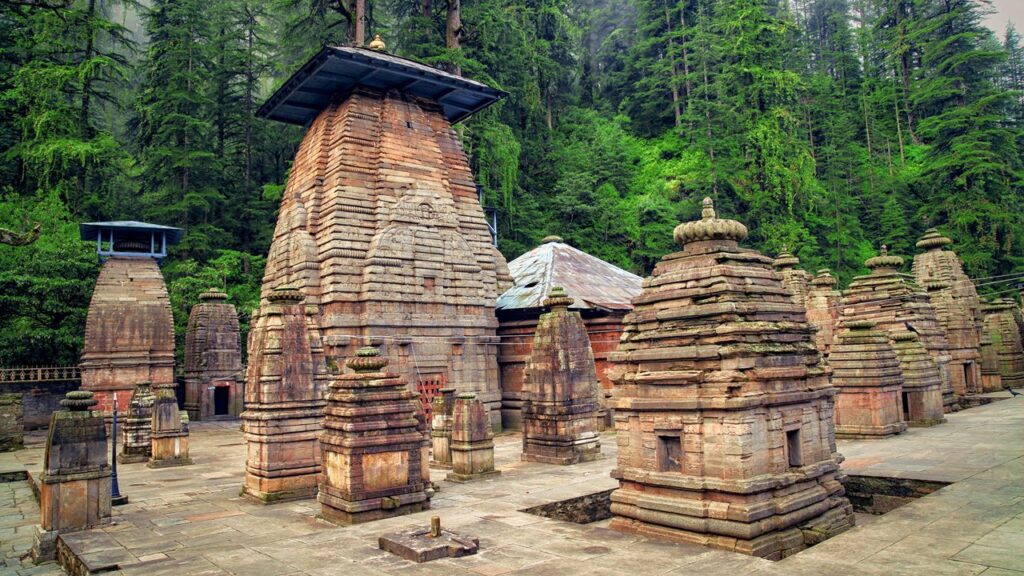
More than a hundred stone temples rest here, scattered across a quiet valley, each one devoted to Lord Shiva. They stand close together, yet never crowd each other—as if respecting an unspoken boundary.
Moss clings to their ancient walls. Time has softened their edges. Some are grand, others humble, but all feel alive.
No bells ring loudly here.
No priests shout instructions.
The temples seem content to exist—waiting patiently for those who arrive with reverence rather than hurry.
When the Forest Becomes the Prayer
At Jageshwar, prayer does not come only from folded hands. It comes from rustling leaves, flowing water, and the soft crunch of footsteps on forest ground.
The forest listens.
It listens to whispered mantras.
It listens to unspoken grief.
It listens to questions that have no answers.
And in return, it offers stillness.
Many believe Jageshwar is not just a place of worship, but a place of healing—where the mind loosens its grip, and the heart learns to breathe again.
Stones That Remember Devotion
Archaeologists will tell you about dynasties, centuries, and inscriptions. But the stones of Jageshwar tell a quieter story—of countless devotees who stood exactly where you stand now.
Saints, travelers, kings, villagers—each left behind something intangible. A prayer. A promise. A moment of surrender.
The stones absorbed it all.
Touching them feels like touching memory itself.
The Flow of Time Slows Here
Time behaves differently in Jageshwar. Minutes stretch. Thoughts fade. There is no urgency to move on, no checklist to complete.
People sit silently for long periods, watching sunlight dance on temple walls. Others walk barefoot, feeling the cool earth beneath them. Some close their eyes and listen—to nothing, and to everything.
In Jageshwar, silence is not empty.
It is full.
The Lingam and the Leaf
A single leaf falling onto a Shiva lingam here feels intentional. A small act, but complete. Jageshwar teaches that devotion does not require grandeur—only presence.
This is not a place that demands belief.
It simply invites awareness.
Leaving the Forest, Carrying the Calm
When you finally leave Jageshwar, the forest does not follow—but its calm does. The noise of the world returns gradually, softened by something you can’t quite name.
You may forget the exact shape of the temples.
You may forget the path you walked.
But you will remember how it made you feel.
Because Jageshwar does not echo loudly in memory.
It settles quietly.
Like a forest that listened—
and understood.