
The houses are still standing.
Walls intact.
Roofs holding firm.
Doors locked carefully—as if their owners stepped out only moments ago.
But no one returns.
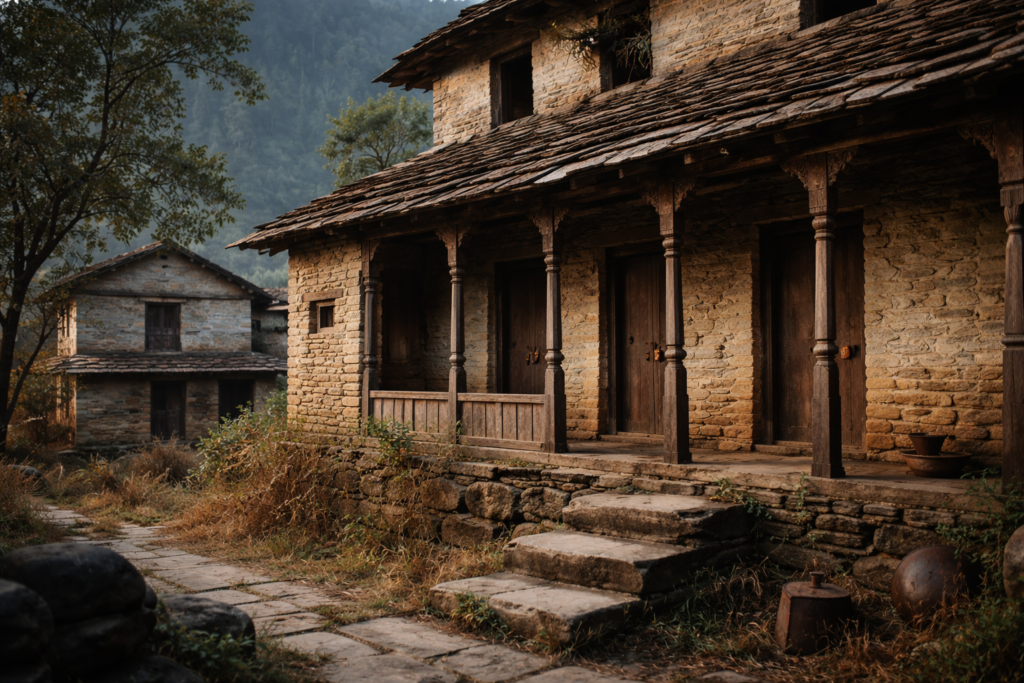
Homes That Refused to Collapse
In the hills, abandonment does not always look like ruin.
These houses have not fallen apart. They have been left behind with dignity.
Inside them are beds still neatly placed, shelves holding steel utensils dulled by time, calendars frozen on forgotten months. Trunks sit in corners, locked with keys that now live far away—in city drawers, in rented rooms, in lives that moved on.
The houses are not broken.
They are paused.
The Language of Locked Doors
Each locked door tells a different story.
Some were locked in urgency—migration forced by illness, debt, or sudden opportunity.
Others were locked with promise—“We will come back after retirement,” “After the children grow,” “After one more year.”
The locks were not symbols of departure.
They were symbols of hope.
Hope ages quietly.
Courtyards That Remember Footsteps
Courtyards once echoed with movement—grains being dried, children running barefoot, elders sitting in winter sun. Today, grass grows where people once gathered.
Rain falls.
Leaves settle.
Time moves carefully.
But the stones remember.
They remember footsteps.
They remember laughter.
They remember life.
Windows That Still Look Out
Some windows remain slightly open—never shut completely.
Through them, light enters every morning, touching empty rooms gently. Wind moves curtains that have not been washed in years. Dust settles and lifts again.
These windows were left open intentionally.
As if the house itself is watching the road.
Waiting.
Why These Houses Do Not Get Sold
People ask: Why don’t they sell these homes?
Because selling feels final.
A sold house belongs to someone else.
A locked house still belongs to memory.
As long as the door remains locked, return remains possible.
Even if unlikely.
Festivals Without Families
During festivals, a few doors open briefly.
Someone returns to clean.
Light a lamp.
Offer prayers.
The house breathes again—for a day, sometimes two.
Then the door is locked once more.
The house resumes waiting.
A Village Made of Absence
A village with many locked houses is not empty.
It is full of absence.
Absence of voices.
Absence of routine.
Absence of future imagined locally.
The houses do not accuse.
They do not collapse in protest.
They simply wait.
What These Houses Teach Us
That migration is not always about leaving—it is about postponing return.
That homes are not abandoned—they are held in suspension.
That villages do not disappear suddenly—they fade while still standing.
These houses are not ruins.
They are promises waiting to be kept.
The Door That Has Not Given Up
Somewhere in the village, there is always one house that feels different.
The lock is newer.
The courtyard swept occasionally.
The path still cleared.
This house has not stopped believing.
And as long as even one house waits, the village has not fully disappeared.