
Almora wakes up slowly, as if it has learned—over centuries—that there is no need to hurry in the mountains.
Before the sun appears, the town exists in a delicate pause. The sky is neither dark nor bright, but a soft wash of grey-blue, like an unfinished painting waiting for its final stroke. The hills sit quietly, layered one behind another, their outlines blurred by mist. In this half-light, Almora feels suspended between dreams and daylight.
The first sound is not of traffic, nor of voices.
It is the temple bell.
A single, measured ring travels across the ridges, slipping through pine branches and tiled roofs, settling gently into the valleys below. Soon another bell answers, and then another, until the town is stitched together by sound—each temple announcing not just the morning, but continuity.
This is how Almora remembers itself each day.
When the Sun Touches the Hills
As the eastern sky begins to glow, the mountains change their colour—slowly, almost shyly. Blue turns to violet, violet to rose, and finally to gold. When the first ray of sunlight touches the distant peaks of the Himalayas, it feels like a blessing passed quietly from the gods to the earth.
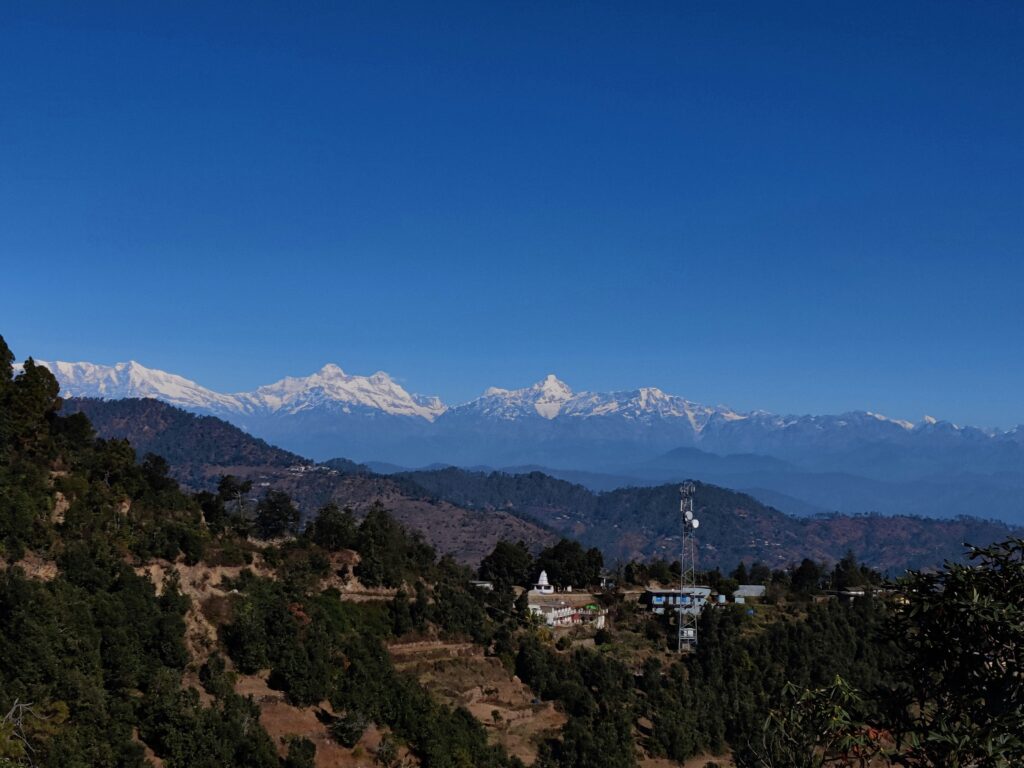
From certain corners of Almora—Kasar Devi road, Bright End Corner, or the edge of a forgotten trail—the view opens wide. Snow-capped giants shimmer far away, impossibly still, as if watching over the town with ancient patience.
Down below, rooftops catch the light one by one. Slate tiles gleam. Smoke curls upward from kitchen chimneys, carrying the smell of burning wood and boiling tea leaves. A new day begins not with urgency, but with acceptance.
Streets That Stretch and Remember
The streets of Almora are narrow, winding, and stubbornly human. They were never meant for speed. They curve where the hill curves, bend where the land demands respect. Walking here feels less like moving forward and more like tracing memory.
Shops begin to open—metal shutters lifted with familiar clangs. The owner of a small tea stall wipes yesterday’s dust from a wooden bench. A newspaper boy pedals past, his stack of folded papers balanced with practiced ease. Somewhere, a radio crackles to life with an old Hindi song, its melody floating between houses.
Vegetable vendors arrive with baskets full of colour—spinach still wet with dew, radishes streaked with earth, scarlet tomatoes glowing against green leaves. Conversations begin softly, as if no one wants to disturb the calm too abruptly.
Almora does not shout itself awake.
It breathes awake.
The People Who Belong to the Morning
There are people who belong especially to Almora’s mornings.
Elderly men walk slowly along familiar paths, hands clasped behind their backs, pausing often—not from tiredness, but from thought. Women sweep courtyards with rhythmic strokes, drawing invisible patterns on stone floors. Children in neatly pressed uniforms wait for school buses, their laughter sharp and brief in the cold air.
Each of them is a thread in the town’s daily weaving.
Some have lived here all their lives. Others have returned after years away, drawn back by something they could never quite explain. Almora has that effect—it allows people to leave, but never entirely lets them go.
The Silence That Speaks
There is a particular silence in Almora’s early hours—a silence that does not feel empty. It hums softly, filled with distant footsteps, rustling leaves, and the low murmur of prayer. Even the dogs seem to understand it, stretching lazily instead of barking.
In that silence, memories surface easily.
For some, Almora is childhood—school walks, winter sun on the face, the taste of freshly fried pakoras on cold evenings. For others, it is refuge—a place to heal, to slow down, to remember a simpler rhythm of living.
And for the first-time visitor, it is revelation.
A Town That Teaches You to Look Up
As the sun rises fully, Almora reveals its true lesson.
Here, the sky is always present. Streets may be narrow, houses close together—but above them, the sky stretches endlessly. No matter where you stand, there is always space to look up, to breathe deeper, to feel small in the best possible way.
Perhaps that is why Almora has always been a place of thinkers, writers, saints, and wanderers. It does not demand your attention. It simply offers itself—quietly, honestly—and waits for you to notice.
Morning Ends, But the Feeling Remains
By the time the town is fully awake, the magic of first light has already slipped into memory. Traffic increases. Conversations grow louder. The ordinary day begins.
But something remains.
A softness.
A steadiness.
A sense that time, here, moves differently.
Almora teaches you that mornings are not just beginnings—they are reminders. That every day, no matter how ordinary it may seem, starts with beauty waiting patiently to be seen.
And if you are willing to wake early enough, the town will share that beauty with you—again and again.