
Some places do not exist merely on the land.
They exist inside you.
Devithal is one such place for me.
Long before I learned to read maps or name destinations, I learned the curves of Devithal’s paths. The way the road bends just before the village appears. The way the air changes—cleaner, cooler, quieter—as if the world has agreed to lower its voice.
Devithal does not announce itself.
It waits.
A Morning That Knows Your Name
Mornings in Devithal arrive gently. There are no alarms here, only rhythms older than memory. A rooster’s call, the soft clang of metal pots in kitchens, the distant lowing of cattle waiting to be led to pasture.
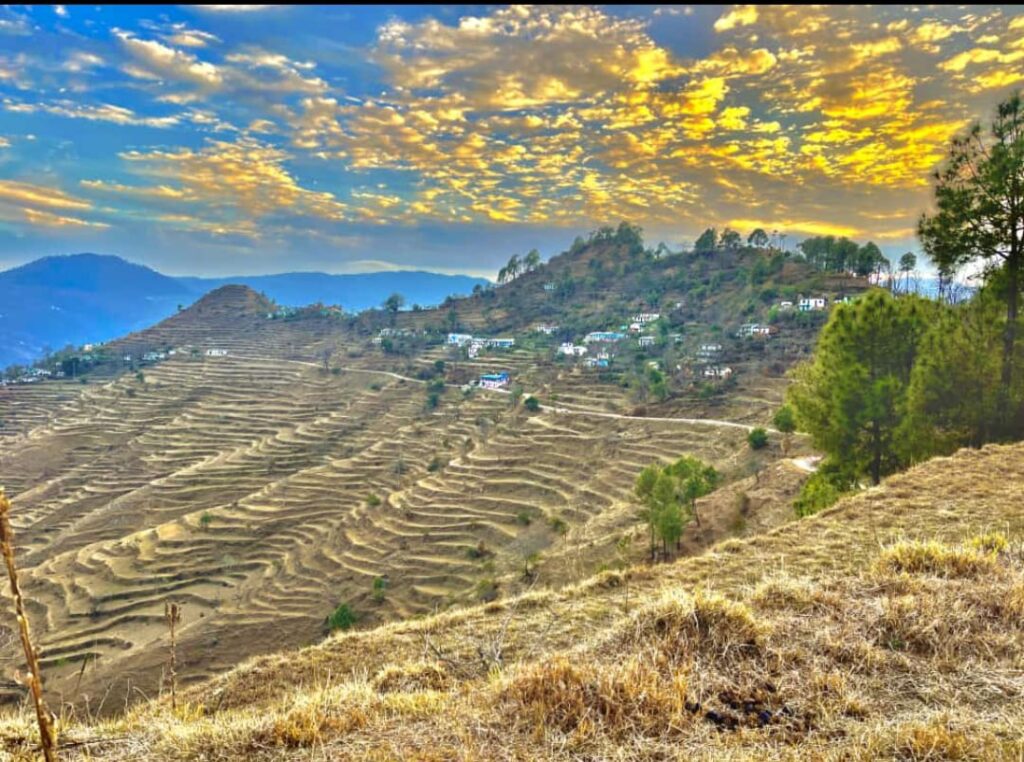
Mist floats lazily between terraced fields, clinging to pine trees like a forgotten dream. The sun rises slowly, touching rooftops one by one, as if greeting each home personally.
In Devithal, the morning feels familiar—
as though it has known you all your life.
Paths Worn by Generations
The footpaths of Devithal are not straight. They curve, climb, and descend according to the will of the mountain. Each stone has been stepped on by countless feet—barefoot children, tired farmers, women carrying grass bundles larger than themselves.
These paths hold stories.
They remember school-bound laughter, wedding processions, festival drums, and silent walks taken during moments of loss. Even today, when I walk them, it feels less like travel and more like returning a borrowed breath.
Houses That Breathe with the Hills
The houses here are modest, strong, and rooted. Stone walls keep the cold out in winter and the heat at bay in summer. Wooden doors creak softly, never in protest—only in greeting.
Inside, kitchens glow with warmth. The smell of madua roti, lentils simmering slowly, and wood smoke lingers like comfort itself. Conversations happen unhurriedly. Time here is measured not in minutes, but in tasks completed and stories shared.
Devithal teaches patience without ever lecturing.
Fields of Gold and Green
Terraced fields ripple across the slopes like waves frozen in time. In different seasons, they change colour—fresh green shoots, golden harvests, resting brown earth awaiting rain.
These fields are not just land.
They are inheritance.
Each crop planted carries hope. Each harvest carries gratitude. Farming here is not an occupation—it is a relationship between people and the mountain that shelters them.
The Silence That Feels Full
Devithal is quiet, but never empty.
The silence here holds the sound of wind in trees, leaves brushing against one another, birds calling from unseen branches. At night, the sky opens itself completely—stars scattered so generously that counting feels pointless.
In that silence, thoughts slow down. The noise of cities, deadlines, and distance fades. What remains is something simpler and stronger—a sense of belonging that does not ask questions.
Leaving, and Always Returning
Like many villages in Kumaun, Devithal has seen its children leave. Jobs, education, opportunity—these call people away. Houses close for years. Paths grow quieter.
But the village remembers.
Every return, no matter how brief, is welcomed without judgment. Devithal does not resent absence. It understands necessity. And when you come back—even after years—it opens itself to you exactly as it was.
Some places change when you leave.
Devithal waits.
Why Devithal Lives in My Heart
Because it taught me how little one truly needs.
Because it showed me strength without pride.
Because it holds my earliest memories and my quietest hopes.
Devithal is not famous.
It is not on postcards.
But it lives—fully, honestly, beautifully.
And no matter how far I go, a part of me always remains here, walking its paths, breathing its air, listening to its silence.
Some villages live on maps.
Devithal lives in my heart.