
There are festivals that celebrate joy, and there are festivals that celebrate devotion.
Then there is Devidhura Bagwal—a ritual so raw, so ancient, that it blurs the line between faith and fear, belief and bravery.
Devidhura does not ask you to understand it.
It asks you to witness it.
A Valley That Holds Its Breath
Nestled in the hills of Kumaun, the village of Devidhura appears quiet for most of the year. The forests surrounding it stand tall and still, as if guarding a secret known only to the land.
But on the day of Bagwal, silence retreats.
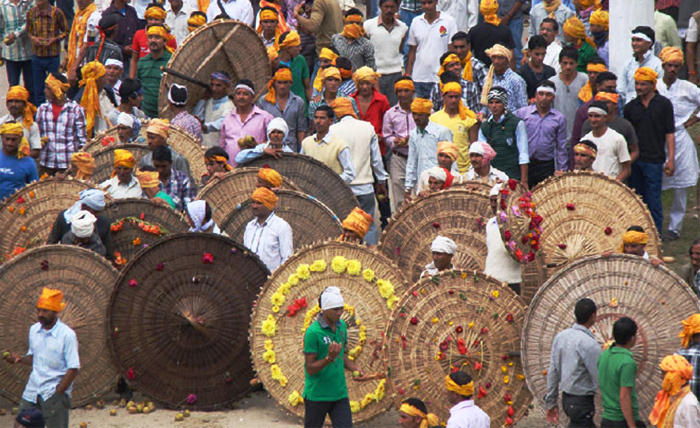
Drums echo across the valley. Voices rise—not in chaos, but in purpose. People arrive from distant villages, towns, and cities, drawn by something deeper than curiosity. Some come as observers. Others come as participants. All come with respect.
The air feels charged, as though the mountains themselves are watching.
The Legend of Golu Devta and the Call of Tradition
The roots of Bagwal stretch far back into Kumauni folklore. It is believed that the ritual began centuries ago as an offering to Golu Devta, the god of justice, to appease divine forces and ensure harmony between clans.
What once may have involved weapons has, over time, transformed into a ritual using stones—symbolic, regulated, and bound by tradition. Yet even today, the act remains powerful.
Bagwal is not violence.
It is faith performed without hesitation.
When the Ritual Begins
As the ritual starts, two groups stand facing each other in the temple courtyard. In their hands are stones, smooth and cold. Around them, chants rise, blessings are murmured, and elders watch closely.
Then, the first stone is thrown.
What follows is not chaos, but rhythm.
Stones fly through the air, striking bodies already prepared to receive them. There is pain—visible, undeniable—but there is also discipline. No anger. No revenge. Only participation.
Faces bleed. White clothes stain red. Yet no one steps back.
Because to step back is to break faith.
Pain as Prayer
In Devidhura Bagwal, pain is not avoided—it is offered.
Each wound becomes a testament. Each drop of blood, a prayer. Participants believe that enduring pain during Bagwal brings blessings, resolves disputes, and fulfills wishes.
It is difficult to explain this belief to the modern mind. From the outside, it may seem brutal. But from within the tradition, it is sacred.
Faith here is not soft.
It is unyielding.
Order Within the Storm
Despite its intensity, Bagwal follows strict rules. Elders intervene if tempers rise. Medical aid stands ready. The ritual ends at a fixed moment, not when exhaustion takes over.
And when it ends, something remarkable happens.
The same people who faced each other moments ago now sit together. Wounds are tended. Water is shared. Smiles appear—tired, quiet, genuine.
There is no victory.
There is no defeat.
Only completion.
After the Stones Fall Silent
As the crowd disperses, Devidhura returns to itself. The drums fade. The valley exhales. Bloodstains are washed away, but the memory lingers.
Bagwal leaves no permanent scars on the land—only on the heart.
For those who witness it, the ritual raises questions about faith, endurance, and the lengths humans go to honor belief. For those who participate, it is not a question at all.
It is inheritance.
What Devidhura Teaches Us
Bagwal teaches us that faith does not always look gentle. That tradition can be uncomfortable, difficult, and deeply misunderstood. But it also teaches restraint, community, and responsibility.
Devidhura Bagwal survives not because it is extreme, but because it is meaningful.
It reminds us that culture is not always meant to be polished for the world. Sometimes, it exists simply to be preserved.
The Mountain That Watches Silently
As evening descends, the hills around Devidhura glow softly in the fading light. The temple stands unchanged, as it has for generations.
The mountains do not judge what happens here.
They remember it.
And long after the stones have fallen silent, Devidhura Bagwal remains—etched into Kumaun’s living memory, a ritual carried forward by faith stronger than fear.