
There was a time when childhood smelled like wet soil, cow dung smoke, and fresh grass.
Today, many children know villages only through stories told by parents and grandparents—stories that feel more like folklore than lived reality.
For thousands of families who migrated from villages to cities, the village has become a memory, not a place. And for their children, it is something they imagine, not something they experience.
This is the quiet story of those children.
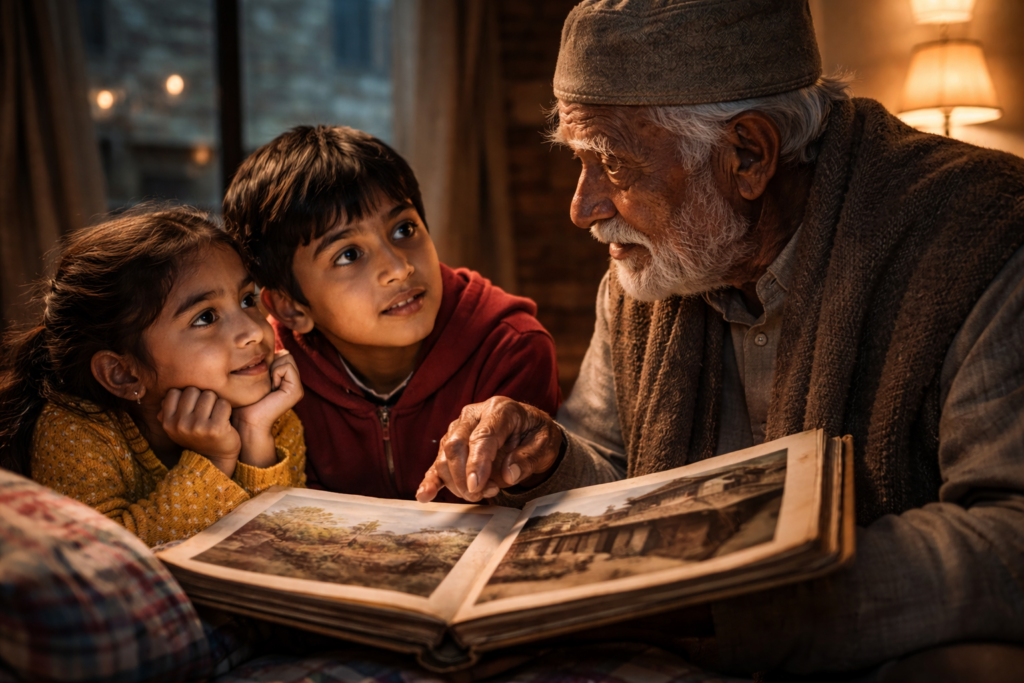
When the Village Becomes a Story, Not a Home
Ask a child whose parents grew up in a village:
- Where is your village?
- What does it look like?
- Who lives there?
The answers are often uncertain.
They know the village has a name.
They know there is an old house—locked most of the year.
They know there are mountains, fields, maybe a temple.
But they have never:
- Walked alone on village paths
- Woken up to rooster calls
- Played barefoot in fields
- Watched elders sit silently at sunset
The village exists only through narration.
Why Today’s Children Don’t Experience Village Life
The reason is not complicated, but it is painful.
1. Migration for survival
Education, jobs, healthcare—everything pulled families towards cities. Staying back was not a romantic option; it was a risky one.
2. Broken village ecosystems
Schools shut down.
Health centers stopped functioning.
Roads came late—or never.
A village without basic services cannot hold young families.
Empty Houses, Full Memories
Most migrated families still have a house in the village.
Locked.
Dusty.
Waiting.
Children hear sentences like:
- “This was my room.”
- “I used to study under that tree.”
- “We had very little, but we were happy.”
But when they visit once in a few years, the house feels unfamiliar—almost чужा (alien).
For a child, memories borrowed from others never feel real.
How Stories Become a Substitute for Experience
Because there is no daily village life, stories fill the gap.
Grandparents narrate:
- Festivals that lasted days
- Community meals
- Shared labour and shared sorrow
Parents add:
- Their childhood freedom
- The simplicity they miss
- The peace they lost
Children listen quietly.
They imagine a place that feels warmer than the city, slower than school schedules, and kinder than concrete buildings.
But imagination cannot replace belonging.
Psychological Impact on Children
This disconnect creates subtle emotional effects:
1. Rootlessness
Children feel they belong to the city—but not deeply.
They belong to the village—but only emotionally.
2. Identity confusion
They introduce themselves as “from the village” yet cannot describe daily village life.
3. Nostalgia without memory
They miss something they never lived.
This kind of inherited nostalgia is heavy.
The Village as a Weekend Destination
For many children, the village becomes:
- A summer trip
- A short Diwali visit
- A background for family photos
Not a living system.
They see:
- Old people
- Empty schools
- Silent evenings
They don’t see:
- Children their age
- Everyday routines
- Future possibilities
Slowly, the village feels like the past, not the future.
What Children Lose Without Village Experience
This loss is not just emotional.
Children miss:
- Learning patience from nature
- Observing community interdependence
- Understanding slow life
- Feeling grounded without constant stimulation
Urban childhood gives speed.
Village childhood gave depth.
Can Villages Survive Only in Stories?
This is the uncomfortable question.
If villages exist only:
- In memories
- In nostalgia
- In stories told to children
Then eventually, they stop existing in reality.
A place survives only when children grow there, not just hear about it.
A Quiet Hope
Sometimes, a child listens carefully.
Sometimes, they ask:
- “Can we stay there longer next time?”
- “Why did you leave?”
- “Can people go back?”
These questions carry a quiet hope—that villages may not remain only stories.
Final Thoughts
Children who know villages only through stories carry a fragile inheritance.
They inherit:
- Love without experience
- Belonging without roots
- Memory without participation
If villages are to survive, they must become places children live in again—not just hear about before sleep.
📌 Stories keep villages alive in words.
Children keep villages alive in reality.